Why CSAT and NPS Miss Your Best Customers
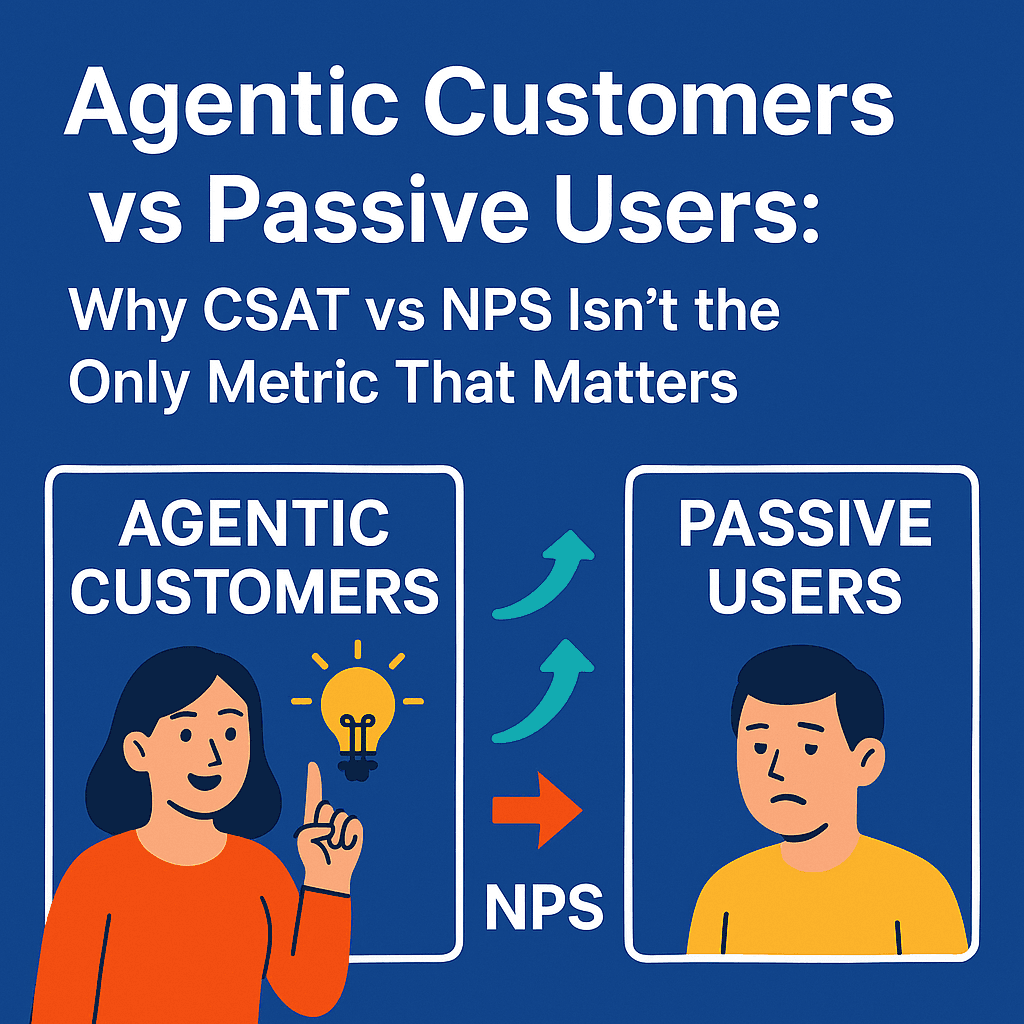
Agentic customers show ~40% higher lifetime value than passive users at the same CSAT — the metric gap that hides your most valuable accounts.
Key Takeaways
- ✓CSAT and NPS measure feeling at a moment, not behavior over time
- ✓Agentic customers show ~40% higher LTV than passive users at equal CSAT
- ✓Track CLV, GRR, and NRR to see the value the survey scores hide
- ✓Behavioral signals (usage, self-service, feedback) predict retention earlier
- ✓Support behavior reveals agentic vs passive before any survey does
Twig for SaaS
Autonomous AI support for SaaS companies.
Two customers give you a CSAT of 5/5. One logs in daily, uses half your feature set, files sharp bug reports, and has referred two peers. The other answered "satisfied" out of politeness and hasn't opened the product in three weeks. Your satisfaction dashboard says they're identical. Your revenue, a year from now, will say they were nothing alike.
That gap is the problem with running customer health on CSAT and NPS alone. They measure a feeling at a moment. They don't measure behavior over time — and behavior is what predicts whether an account renews, expands, or quietly disappears.
TL;DR: CSAT and NPS capture sentiment, not engagement. "Agentic" customers — who actively use the product, self-serve, and give feedback — show roughly 40% higher lifetime value than passive users at the same satisfaction score. Track CLV, GRR, and NRR alongside the survey scores, and use product and support behavior to spot your most (and least) valuable accounts before any survey does.
What CSAT and NPS Actually Measure — and Don't
- CSAT rates one interaction. A great answer to a billing question produces a 5 — and tells you nothing about whether the customer uses the product.
- NPS asks about likelihood to recommend, which swings with the most recent experience and short-term mood.
Both are useful guardrails. Neither captures the full journey, long-term engagement, or — critically — the difference between a passive user and an agentic one. Run your strategy on them alone and you get confident blind spots: churned accounts that were "satisfied" right up until they left.
Passive vs. Agentic: The Distinction That Predicts Value
| Passive user | Agentic customer | |
|---|---|---|
| Product usage | Narrow, sporadic | Broad, habitual |
| Support behavior | Goes silent, or escalates everything | Self-serves, asks sharp questions |
| Feedback | None | Detailed, actionable |
| Advocacy | None | Reviews, referrals |
| Lifetime value | Baseline | ~40% higher at the same CSAT |
The agentic customer isn't necessarily more satisfied on a survey — they're more engaged. And engagement, not satisfaction, is what compounds into retention and expansion.
The Metrics That See What Surveys Miss
To make agentic value visible, pair your survey scores with behavioral and revenue metrics:
- Customer Lifetime Value (CLV) — total value across the relationship; agentic customers cluster at the top.
- Gross Revenue Retention (GRR) — recurring revenue kept, excluding expansion. A clean read on whether customers stay.
- Net Retention Rate (NRR) — includes upsell and cross-sell; agentic customers drive it through deeper usage.
- Leading behavioral signals — feature breadth, self-service rate, feedback participation. These move before CLV or NRR, so you can act while it still matters.
For tooling that surfaces these patterns, see AI customer analytics tools.
Why Support Behavior Is the Earliest Tell
You don't have to wait for a quarterly survey to know who's disengaging. The support queue shows it in real time:
- Agentic customers self-serve the routine stuff and escalate only what's genuinely hard — and when they do, the question is specific.
- Passive users either go silent (the dangerous one) or escalate everything because they never built confidence in the product.
An autonomous AI support layer like Twig reads these patterns automatically. It resolves the routine questions instantly and flags the behavioral shift — an account that suddenly stops self-serving, or one whose tickets turn frustrated — to the account owner before NPS ever catches it. That's a churn signal weeks earlier than the survey.
Turning Passive Users Into Agentic Customers
You don't lecture customers into engagement — you lower the cost of it:
- Personalized prompts. Use behavior to nudge the next useful action, not generic blasts.
- Feedback loops that visibly act. When a customer sees their input shipped, they engage more. When it vanishes, they stop.
- Frictionless self-service. The easier it is to try, find, and fix things, the more passive users cross into agentic behavior. (This is where fast, accurate support pays off — see AI assistants and client retention.)
Common Pitfalls
- Running health off CSAT/NPS alone. They're guardrails, not a strategy.
- Treating all "satisfied" customers as equal. A satisfied non-user is a future churn.
- Ignoring the silent accounts. No tickets and no usage isn't "no problems" — it's the loudest warning you'll get.
- Measuring sentiment but never behavior. The behavior is where the money is.
The Bottom Line
CSAT and NPS tell you how customers felt; they don't tell you what customers do. Your most valuable accounts — the agentic ones — hide in plain sight behind average survey scores. Add CLV, GRR, and NRR, watch the behavioral signals, and read your support queue, and the ~40% value gap between agentic and passive customers stops being invisible.
Twig turns that support queue into an early-warning system, resolving the routine questions and surfacing disengagement before any survey does.
See how Twig reveals at-risk accounts early →
Common questions are answered in the FAQ below.
Try Twig free — see how autonomous AI support works on your tickets
30-minute setup · Free tier available · No credit card required
Frequently Asked Questions
Why do CSAT and NPS miss important customer behaviors?
Because they measure a feeling at a moment, not behavior over time. CSAT is a snapshot of one interaction and NPS swings with short-term emotion. Neither distinguishes a passive user who's "satisfied" but disengaged from an agentic customer who actively uses the product, self-serves, and refers others — even though those two have very different lifetime value.
What metrics better measure real customer engagement?
Behavioral and revenue metrics: Customer Lifetime Value (CLV), Gross Revenue Retention (GRR), and Net Retention Rate (NRR), plus leading behavioral signals like feature breadth, self-service rate, and feedback participation. These capture what customers do, not just how they felt about one ticket.
AI Customer Analytics ToolsHow do you convert passive users into agentic customers?
Make engagement effortless and rewarded: personalized prompts based on behavior, feedback loops that visibly act on input, and a frictionless self-service path so trying things never feels risky. The lower the effort to engage, the more passive users cross into active, agentic behavior.
AI Assistants Lift Client RetentionCan support data reveal agentic vs passive customers?
Yes — it's one of the clearest signals. Agentic customers self-serve and ask sharper questions; passive ones go silent or escalate everything. An autonomous support layer like Twig surfaces these patterns automatically, flagging disengaging accounts before a quarterly NPS ever catches them.
Related Pages
Integrations
Industries
Weekly AI CX insights
How leading support teams deploy autonomous AI. One short email a week.
Related Articles
What should CX leaders budget for AI support in 2026?
2026 AI support budgets vary by company size and industry, with deflection rates ranging 15-85% based on implementation maturity levels.
13 min readWhat are the stages of AI support maturity from pilot to autonomous?
AI support maturity follows five stages from basic pilot (10% deflection) to full autonomous resolution (60-70% deflection) with specific metrics benchmarks.
15 min readHow to Calculate AI Support ROI (12-18 Mo Payback)
Calculate AI support ROI before buying — cost per ticket, deflection rate, payback period. Industry benchmark: 12-18 mo at 2,000+ tickets/mo.
10 min read